Blog
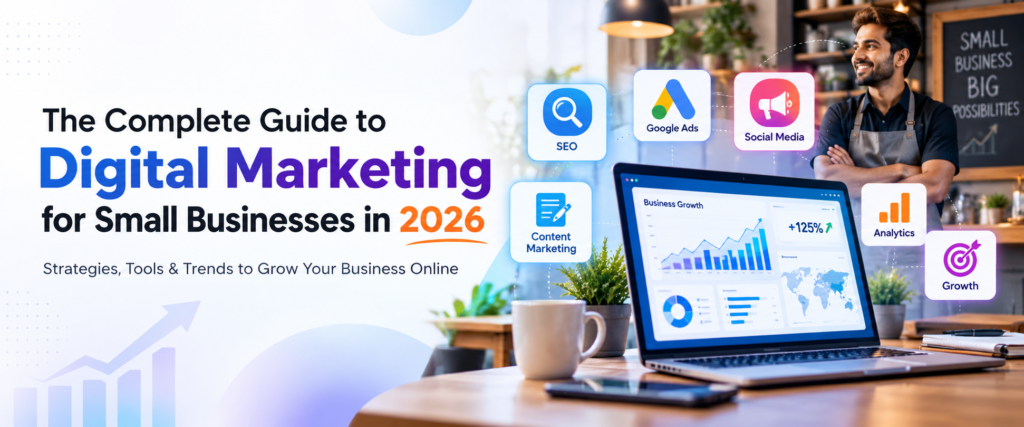
In today’s competitive digital landscape, simply having a business is no longer enough. Whether you own a local retail store, restaurant, coaching institute, clinic, real estate company, or an eCommerce brand, your customers are searching online before making a purchase.
According to recent industry trends, most consumers research a business online before contacting or visiting it. If your business doesn’t have a strong online presence, you’re likely losing potential customers to competitors who do.
Digital marketing has become the most cost-effective way for small businesses to attract new customers, build trust, increase sales, and grow sustainably. Unlike traditional advertising methods such as newspapers, billboards, or flyers, digital marketing allows businesses to reach the right audience at the right time while tracking every rupee spent.
This comprehensive guide will help you understand everything you need to know about digital marketing in 2026 and how your business can benefit from it.
Digital marketing refers to promoting products or services using online platforms and digital channels.
These channels include:
Instead of waiting for customers to find you, digital marketing helps you actively reach people who are already interested in your products or services.
Many business owners believe digital marketing is only for large companies. In reality, small businesses often benefit even more because digital marketing levels the playing field.
Some key benefits include:
People cannot buy from a business they don’t know exists.
Digital marketing helps your business appear on Google, Facebook, Instagram, YouTube, and other platforms where your customers spend their time.
Traditional advertising often requires large budgets with limited tracking.
Digital marketing allows businesses to:
This means every marketing decision is backed by real data.
Instead of attracting random visitors, digital marketing helps you reach people who are actively searching for your services.
A plumbing business can target homeowners.
A dentist can target people nearby searching for dental care.
A clothing store can target fashion enthusiasts.
The result is higher-quality leads and better conversion rates.
SEO is the process of improving your website so it appears higher in Google search results.
Imagine someone searches:
If your website ranks on the first page, you receive free organic traffic.
SEO takes time, but it delivers sustainable results.
Millions of people use social media every day.
Platforms like Instagram, Facebook, LinkedIn, YouTube, and Pinterest provide incredible opportunities for businesses.
Consistency is more important than posting every day.
Content marketing means creating valuable content that helps your audience solve problems.
High-quality content builds trust before asking customers to buy.
Google also rewards useful content with better rankings.
Google Ads help businesses appear instantly in search results.
Unlike SEO, which takes time, Google Ads can generate traffic immediately.
Meta Ads include Facebook and Instagram advertising.
These platforms allow businesses to reach audiences based on:
Popular ad formats include:
Email marketing remains one of the highest ROI marketing channels.
Businesses can use email for:
A strong email strategy helps build long-term customer relationships.
Your website is your digital storefront.
An effective business website should be:
Every page should encourage visitors to take action.
If your business serves a specific location, Local SEO is essential.
Optimize:
Local SEO helps nearby customers find your business quickly.
Many businesses fail because they make avoidable mistakes.
These include:
Posting randomly rarely produces consistent results.
Create a monthly marketing plan.
Without SEO, your competitors will continue attracting your potential customers.
Slow-loading websites drive visitors away.
Improve speed and user experience.
Every social media post should educate, entertain, or inspire action.
Always track:
Analytics help improve future campaigns.
Businesses should keep an eye on emerging trends.
These include:
Staying updated helps businesses remain competitive.
Step 1
Define your business goals.
Examples:
Step 2
Understand your target audience.
Identify:
Step 3
Create a professional website.
Step 4
Invest in SEO.
Step 5
Publish quality content regularly.
Step 6
Use social media consistently.
Step 7
Run paid advertising campaigns.
Step 8
Track analytics and optimize continuously.
Digital marketing is an ongoing process, not a one-time activity.
Yes. Digital marketing offers affordable and measurable ways for small businesses to reach potential customers and compete effectively.
SEO generally starts showing noticeable results within 3–6 months, depending on your industry, competition, and website quality.
It depends on your audience:
Google Ads provides immediate visibility, while SEO builds long-term organic traffic. Combining both often delivers the best results.
Budgets vary by industry and goals, but even modest, consistent investments can generate meaningful growth when paired with the right strategy.
Digital marketing is no longer a luxury for small businesses—it’s a necessity. Whether you’re looking to increase brand awareness, attract more customers, or boost sales, a well-planned digital strategy can help you achieve sustainable growth.
By combining SEO, content marketing, social media, paid advertising, email campaigns, and a user-friendly website, businesses can build a strong online presence and stay ahead of the competition.
Success doesn’t happen overnight, but with consistency, data-driven decisions, and continuous optimization, digital marketing can become one of your most valuable business investments.
At Hope Digital Media, we help businesses build a strong digital presence through SEO, website development, social media marketing, Google Ads, Meta Ads, content creation, video editing, and complete digital marketing solutions.
Whether you’re a startup or an established business, our team creates customized strategies that deliver measurable results and long-term growth.
Get in touch with Hope Digital Media today and take the next step toward growing your business online.
Our Solution
Quick Links
Contact Us
Copyright
WhatsApp us